Leading When the Plan Keeps Changing: Six Principles for Adaptive Project Leadership
by Giulia Morello
Foreword
This article was inspired by Giulia Morello’s successful seminar with the PMI Gothenburg Network, How Do You Lead a Project When the Plan Keeps Changing? We wanted to make the insights and practical knowledge shared during the event accessible to project professionals across Sweden. Drawing on her experience in complex transformations and international projects, Giulia shares six principles of adaptive leadership to help project leaders navigate uncertainty, influence people and keep teams moving forward when the way ahead is unclear.
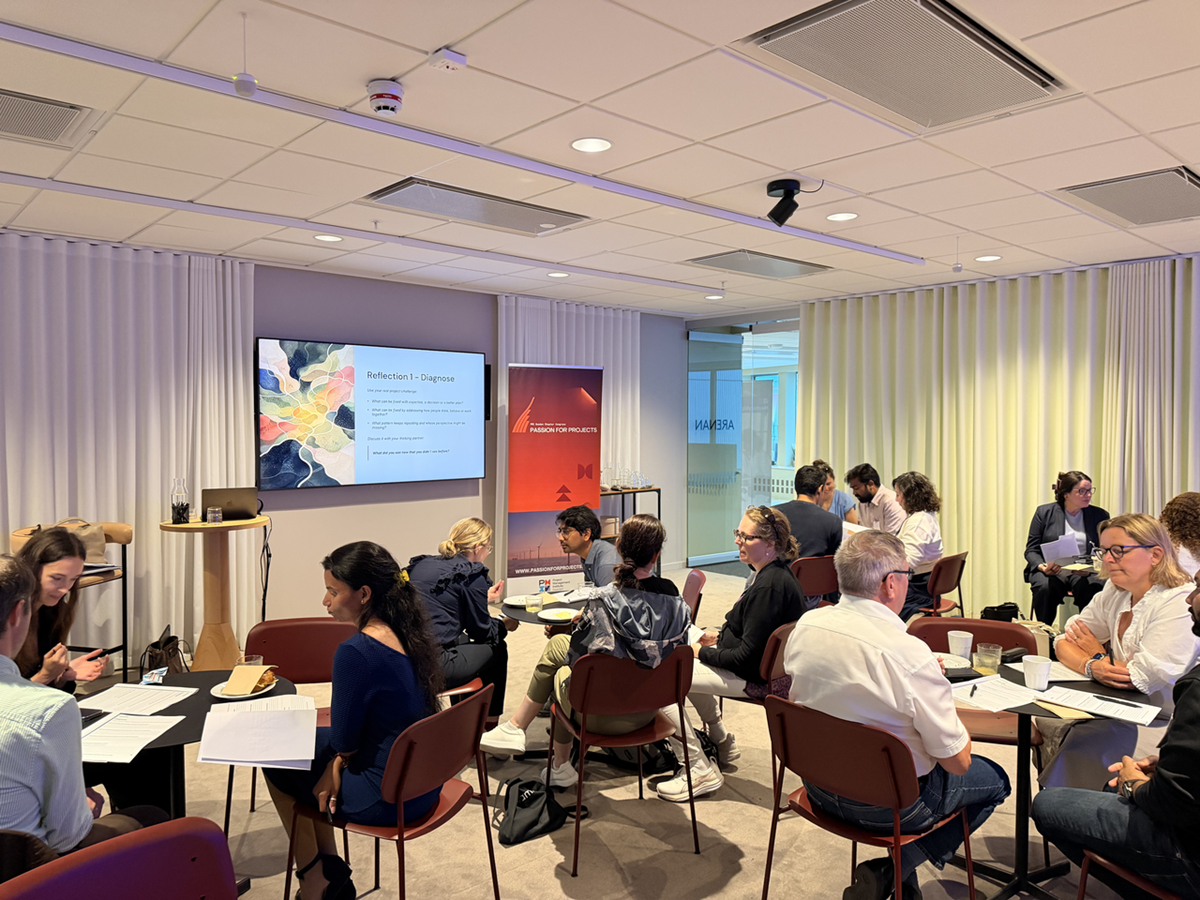
Seminar for Gothenburgs Network, August 27th, 2026.
About Giulia Morello
Giulia is an engineering operations, transformation and people leader with extensive experience guiding international organizations through complex change. She is an international speaker and coach, winner of the 2023 PMI Changemaker Award in the Leadership category, and a finalist for the 2026 PMI Rising Leader Award.
Working in the global automotive industry, she leads multidisciplinary teams and initiatives spanning engineering operations, product lifecycle management, organizational transformation and operational excellence. Her experience includes leading major digital transformation programs and supporting company carve-outs and multinational integration.
Giulia is passionate about helping leaders create clarity in complexity, develop people and build effective collaboration across organizational and cultural boundaries.

Giulia Morello
Six Principles for Adaptive Project Leadership
There is a point in many projects where the original plan is still clear on a dashboard, but everyone in the room already knows that reality has shifted.
A dependency has changed, a decision came too late, a key stakeholder has switched direction, or the organization around the project is no longer the same one you started with. At that point, the question is not simply whether the plan needs to be updated. The bigger question is how we lead when uncertainty has become a constant in projects.
This is something I have experienced repeatedly in my own work across company separations, digital transformations, international integrations, and complex engineering programs. I still believe strongly in structure, governance, clear ownership, and good planning. But I have also learned that some challenges cannot be solved by adding more detail to a plan.
Over time, and through many conversations with other project leaders, I started reflecting more consciously on what the role really requires today. The more I looked at my own experience, the more I realized that being a project leader is no longer just about controlling a plan, tracking milestones or managing risks. In complex environments, a large part of the job is about moving people, helping teams through uncertainty and guiding them through changes that are often bigger than the project itself.
That is where the concept of adaptive leadership started to resonate with me. It gave a name to something I had already experienced many times in practice: situations where the leader cannot simply provide the answer, because the answer has to be developed together with the team while the environment keeps changing.
Through that reflection, I developed six principles that have been particularly important in my own work. They are not a methodology or a fixed formula. They are lessons I wish I had known earlier, and that I hope can help other project leaders who currently find themselves in the same kind of situations.
1. Name the Challenge Correctly
I think one of the most common mistakes we make as project leaders is trying to solve every problem with the same logic. We identify the gap, define an action, assign an owner, and follow up. It is a very natural way of working, and often the right one. But I have learned that some challenges do not respond to that approach at all. Before trying to fix the problem, we need to understand what kind of problem we are actually dealing with.
A technical problem can be difficult, but the solution is generally known. You apply the correct expertise and processes to solve it.
An adaptive challenge is different. The answer is not predefined, and the difficulty often sits in shifting behaviours, assumptions, ways of working, and sometimes even identity.
During our Digital Transformation, we spent a lot of energy improving processes, adding follow-up, or creating more documentation when the real issue was that people had not yet bought into the new way of working, were uncomfortable with changing systems, or wanted to work just as they did for decades in the previous company.
In those cases, the challenge was not the process itself. The challenge was helping people adapt. When we focused on working with leaders to work on promoting our vision and new way of working, that’s when things really took off.
This distinction matters because the wrong diagnosis usually leads to the wrong response. So always try to identify what type of issue you are facing, and apply the right toolkit to solve it.
2. Walk Slowly Through the Crowd
Project leaders are usually rewarded for speed. We are expected to react quickly, make decisions and keep things moving.
But speed can become a problem if we move before we properly understand what is happening.
“Walk slowly through the crowd” is a reminder to observe before intervening. When you are in a room, observe: Who is speaking? Who is staying silent? What motivates or demotivates people? What patterns keep repeating?
I have had workshops at the beginning of our international Joint Venture where I used this technique to first assess the room. That taught me much more than jumping directly into discussions and solutions and gave people enough space to express their thoughts.
Sometimes the most useful thing a leader can do is slow down enough to see what is really going on. A few more questions and observing at the beginning can save a great deal of time later.
3. Be the Pace Setter
When pressure increases, people watch leaders closely.
They watch how we react, how we communicate, and how we behave when things do not go according to plan. That is why leadership under pressure is often less about what we say and more about how we act.
Being the pace setter means leading by example and creating a rhythm that helps the team move forward without adding unnecessary stress. It means being consistent, communicating openly, and showing the behaviour you expect from others.
In many transformations, the surrounding organization changes while the project still has commitments to meet. Deadlines do not automatically move just because the environment has become more complex.
In those situations, I have found that people do not need artificial certainty. They need clarity about what is known, what is still uncertain, what matters most now, and what can wait.
That is also where trust is built. If we expect openness, we need to be open. If we expect calm, we need to avoid creating panic. If we expect accountability, we need to demonstrate it ourselves.
A leader sets the emotional and operational pace much more than we sometimes realize.
4. Hold the Line
Think about one of the biggest projects you have worked on or led. One of those projects you still remember years later, the kind you mention to a former colleague over coffee and say, “Do you remember what we went through?”
Now let me ask you this: was it comfortable?
Most of you probably answered “no”. The projects we remember most are often the ones that stretched us, forced us to learn, and made us grow. They were also the ones where uncertainty, pressure, and difficult conversations were part of the journey.
And the uncomfortable truth is that when things become difficult, people naturally look for a way out: blame games, endless meetings, avoiding meaningful conversations, or procrastination.
I also fell into these traps sometimes. But adaptive leadership means resisting that instinct to back away when things become difficult. Instead, we need to face the issue and help the team move through it. Instead, they face the problem to build momentum. A useful question I try to ask myself is: what am I postponing because it is uncomfortable, rather than because it is unnecessary?
Sometimes the answer is a difficult stakeholder discussion. Sometimes it is a decision on priorities. Sometimes it is admitting that two parts of the organization are not as aligned as we would like them to be.
Leaders do not need to make every situation comfortable. But they do need to create enough stability for the team to face what is difficult and keep moving forward.
5. Empower People
One of the easiest habits to fall into as a leader is solving too much yourself.
It often starts with good intentions. Someone comes with a problem, you know the answer, so you help. A discussion is moving slowly, so you step in. A task is not progressing as expected, so you take control.
In the short term, this can be efficient. In the long term, you overload yourself, and what’s worse, you deprive people of the opportunity to grow.
Adaptive leadership is focused on capacity-building. The role of the leader is not simply to distribute tasks, but to create the conditions for more people to take ownership, make decisions at the right level, and grow into greater responsibility.
That means giving people room to test ideas, learn from experience and take responsibility for the outcome. It also means resisting the instinct to step in too early and solve everything yourself.
I have seen this many times in complex projects. When people are trusted with meaningful ownership, some of them step up in ways you did not expect. They take on more, develop new competencies, and sometimes grow into completely new roles.
Little by little, you stop having a project that depends on a few key individuals and start building a much stronger group of people who can carry the work together with you.
That, for me, is what capacity-building really means. You are not only delivering the project in front of you. You are increasing the organization’s ability to deliver the next one as well.
6. Build Cultural Awareness
The final principle has become increasingly important in my own work because many of the projects and transformations I have led have involved people from different countries, organizations, and working cultures.
But today, this is the new normal. Most project leaders work in multicultural teams, whether those people sit in the same office or across different countries and time zones.
That makes cultural awareness a core leadership skill. People communicate differently, build trust differently, relate to hierarchy differently, and handle disagreement differently. A direct style may feel efficient to one person and confrontational to another. Silence may mean agreement, hesitation, or simply respect for hierarchy.
The principle I come back to is simple: in multicultural teams, curiosity is often more valuable than expertise.
Ask instead of assuming. Pay attention to how decisions are really made, how people prefer to communicate, and what helps them feel comfortable speaking up. Assumptions are one of the fastest ways to damage trust in a team. Curiosity is one of the fastest ways to build it.
You do not need to become an expert in every culture represented in the team. You do need to be curious enough to notice the differences and intentional enough to build a shared understanding and team culture around them.
Adaptive Leadership Still Needs Structure
One thing I want to make clear is that adaptive leadership is not the opposite of good project management.
It does not mean lowering standards, removing governance, or accepting constant change without discipline.
In fact, the more uncertain the environment becomes, the more useful clear structure can be.
The difference is that the structure needs to support reality rather than defend the original plan at all costs.
Good governance still matters. Clear ownership still matters. Milestones still matter. But leaders also need to be able to recognize when the assumptions behind those structures have changed.
That is where the six principles become useful. They are reminders of where to look when the normal project tools are no longer enough.
Name the challenge correctly. Slow down enough to understand the system. Set the pace. Stay with the difficult issues. Give people real ownership. And remain curious about the different ways people think, communicate and work.
The plan will change at some point. Most experienced project leaders already know that.
What matters is what you do next.
The strongest teams I have worked with were not the ones where nothing unexpected happened. They were the ones that could absorb change without losing direction, adapt without losing accountability, and keep moving without pretending to have every answer.
That, for me, is the real value of adaptive leadership: not having the perfect plan, but being able to lead well when the plan is no longer perfect.
2026-11-03